Protecting Your Health After 60: The Ultimate Vaccine Guide to Avoid the Hospital
Authored By: Dr. Kamales Kumar Saha | Preventive Healthcare Leader & Veteran Cardiac Surgeon (35+ Years Clinical Experience, 7,000+ Major Surgeries)
How a proactive immunization plan shields your blood sugar, prevents severe inflammatory complications, and keeps you safe, stable, and out of the ER.
India's Silent Adult Vaccination Gap
Most Indians associate vaccines exclusively with childhood pediatric schedules. Few realize that adulthood has its own essential immunization timeline.
India is currently home to more than 100 million people living with diabetes, alongside millions more battling obesity, hypertension, and metabolic syndrome. Yet, adult vaccination remains one of the most neglected preventive interventions in the country.
National studies and expert consensus reports consistently highlight a dismal uptake of adult vaccines among eligible Indians, particularly for influenza, pneumococcal disease, and shingles. As a result, countless older adults remain completely vulnerable to preventable hospitalizations, severe clinical complications, and a sudden loss of physical independence.
Preventive healthcare is never measured by how many medicines or supplements you take. It is measured entirely by the diseases and hospitalizations you successfully avoid.
The consequences of ignoring this gap are entirely predictable:
- Seasonal Surges: A massive spike in hospital admissions during peak influenza season.
- Pulmonary Crises: Severe, preventable pneumonia-related complications in older demographics.
- Metabolic Chaos: Uncontrolled, erratic diabetes blood sugar spikes triggered by viral stress.
- Vascular Ruptures: Acute cardiovascular events following severe, systemic inflammatory illnesses.
The Real Threat Is Not the Virus. It Is the Inflammation That Follows.
When a healthy 30-year-old contracts influenza, their recovery is typically straightforward. But when a 65-year-old South Asian managing diabetes and abdominal obesity encounters the exact same virus, the underlying biology is fundamentally different.
The standard Western body mass index (BMI) thresholds of 25 and 30 consistently fail to accurately capture the true metabolic risks for the Indian population. Due to the highly prevalent "thin-fat" phenotype in India—where a normal or mildly elevated BMI often hides dangerously high levels of visceral fat wrapping around internal organs—the immune and inflammatory response is significantly altered.
The moment an infection takes hold, it triggers an aggressive surge of inflammatory chemicals (cytokines) throughout the body:
- Insulin Resistance Spikes: Stress hormones lock up cell receptors, causing blood sugar levels to skyrocket.
- Vascular Instability: The endothelium (blood vessel lining) becomes highly inflamed and fragile.
- Plaque Vulnerability: Existing, quiet arterial plaque becomes highly vulnerable to cracking or rupturing.
This is precisely why acute infections frequently precede heart attacks, strokes, sudden heart failure admissions, and rapid metabolic deterioration in older adults. For patients with metabolic disease, preventing systemic inflammation is just as critical as preventing the infection itself.
The Respiratory Shield: Influenza and Pneumococcal Vaccines
Many people dismiss influenza as "just a viral seasonal fever." After the age of 60, that assumption becomes dangerous.
Influenza Vaccination: An Overlooked Heart Protection Strategy
While patients view the flu shot as a defense against a cough, modern cardiologists view it as a direct shield for the cardiovascular system.
Over the last decade, extensive meta-analyses have conclusively reported that annual influenza vaccination is associated with a highly significant reduction in major cardiovascular events, strokes, and cardiac mortality among high-risk patients.
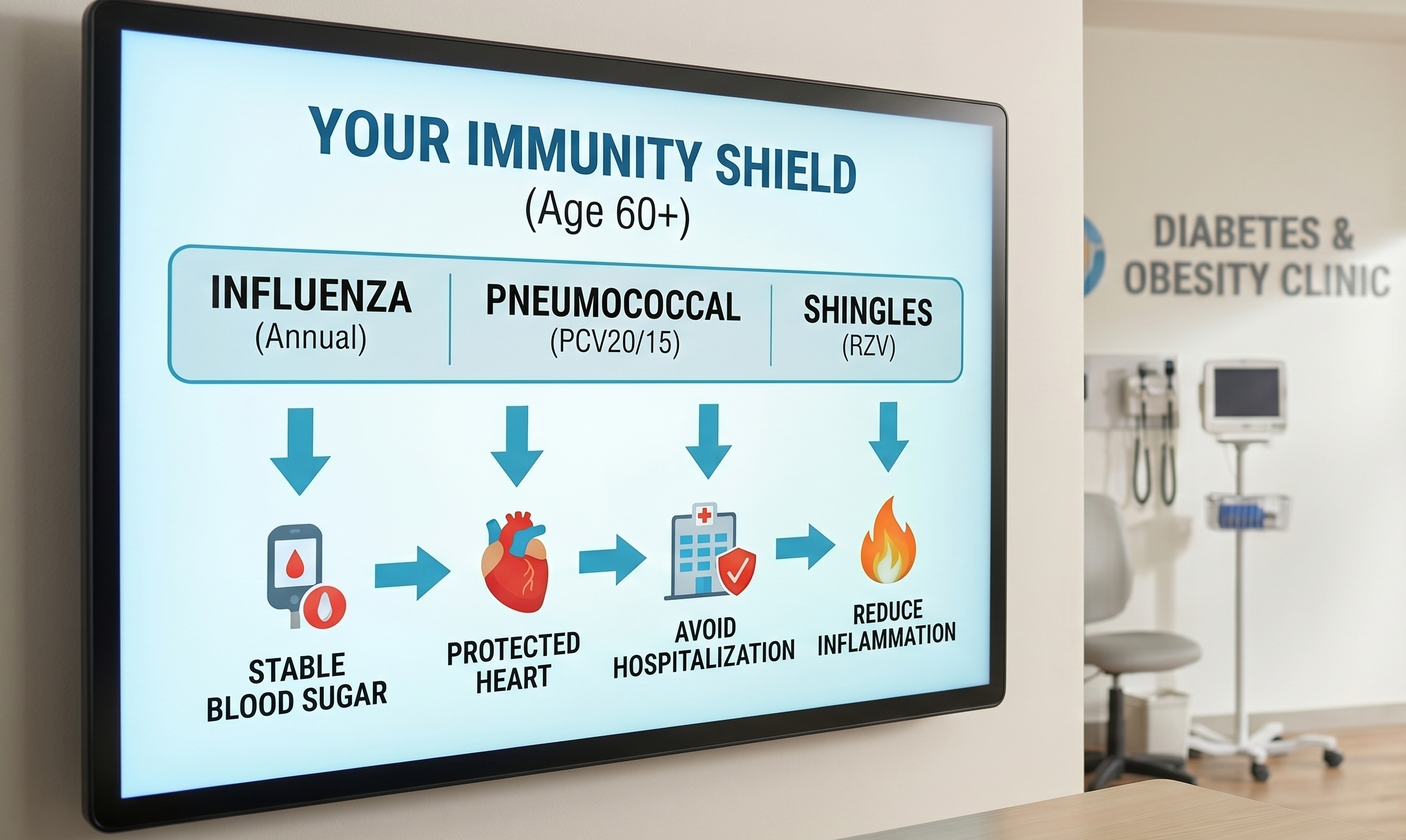
The biological explanation is entirely straightforward: by stopping the flu, you prevent the accelerated heart rate, blood clotting tendencies, and inflammatory shockwaves that cause coronary arteries to fail. For individuals navigating diabetes or hypertension, the annual flu shot must be integrated directly into your cardiovascular risk-reduction plan.
- Target Groups: Recommended annually for adults aged 50+ living with diabetes, prediabetes, obesity, heart disease, or chronic kidney/lung conditions.
- Clinical Benefit: Vaccinated individuals who still contract influenza generally experience milder illness, lower hospitalization rates, and faster recovery.
Pneumococcal Vaccine: Protecting the Lungs and the Heart
Pneumococcal bacteria remain a leading driver of severe pneumonia, bloodstream infections (sepsis), and meningitis in older demographics.
Just as we track arterial health through modern imaging or monitor long-term metabolic health, updating your pneumococcal status is an essential metric in modern longevity medicine. Current clinical recommendations heavily favor newer, highly effective conjugate vaccines such as PCV20 or PCV15, which simplify older, multi-shot schedules into a highly efficient defense line. For older adults, pairing the influenza and pneumococcal vaccines together builds the strongest respiratory defense available.
The Metabolic Stabilizer: Protecting Blood Sugar from Infection-Driven Chaos
Every significant infection activates an immediate emergency release of stress hormones, primarily cortisol and adrenaline. This chemical surge triggers a volatile reaction:
- Acute Hyperglycemia: Your liver dumps glucose into the blood while tissues resist insulin, turning stable metabolic control into an overnight medical emergency.
- Dehydration and Kidney Strain: High blood glucose forces the kidneys into overdrive, creating a rapid loop of fluid loss and potential acute kidney injury.
Immunization must therefore be repositioned as a core component of routine metabolic management. Preventing an infection means preventing the severe metabolic destabilization that leads to emergency medical intervention. Good diabetes care is not simply about lowering HbA1c; it is about preventing the acute events that destabilize metabolic health.
The Long-Term Safeguard: Shingles and Tdap Protection
Shingles (Herpes Zoster): Preserving Quality of Life
Few conditions are as clinically underestimated as shingles. The chickenpox virus remains completely dormant inside your nerve tissue for decades, waiting for the natural immune decline of aging (immunosenescence) to reactivate. This risk rises exponentially after age 50, particularly in those with diabetes.
While the visible skin rash eventually resolves, the underlying nerve damage often does not. Post-herpetic neuralgia can persist for months or even years, causing agonizing, burning pain, severe sleep disturbances, and a profound loss of personal independence.
The modern recombinant shingles vaccine (RZV) provides greater than 90% protection against the virus and its chronic nerve pain complications. Furthermore, emerging neuroinflammatory research suggests that keeping this viral reactivation at bay aligns beautifully with long-term therapeutic goals aimed at maintaining low systemic inflammation to halt long-term plaque progression. Two doses are recommended for adults aged 50 and older.
The Forgotten Shield: Tdap
Many older adults operate under the false assumption that childhood tetanus shots last a lifetime. They do not. The Tdap vaccine provides critical, ongoing defense against Tetanus, Diphtheria, and Pertussis (Whooping Cough).
- Dosing Schedule: Adults require at least one dose of Tdap in adulthood, followed by a booster every 10 years.
- Family Cocooning: This is especially vital for grandparents who have close, frequent contact with newborn infants, acting as a shield of safety for vulnerable family members.
Summary: The Adult Immunization Defensive Strategy
| Vaccine | Traditional Perception | Modern Clinical Reality | Core Patient Benefit |
| Influenza (Annual) | Prevents seasonal cough and body aches | Reduces systemic inflammatory shock and vascular clotting tendencies | Enhanced heart protection, fewer cardiac admissions, and stable blood sugar |
| Pneumococcal (PCV20/15) | Prevents standard chest colds | Prevents invasive bacterial pneumonia and secondary bloodstream sepsis | Drastically reduces emergency respiratory hospitalizations |
| Shingles (RZV - 2 Doses) | Prevents a temporary painful skin rash | Prevents long-term neuroinflammation and chronic nerve damage | Preserves daily mobility, sleep quality, and personal independence |
| Tdap (10-Year Booster) | Simple rust/injury precaution | Maintains critical immunity against tetanus, diphtheria, and pertussis | Long-term personal safety and protective cocooning for infants |
| Hepatitis B | Prevents acute jaundice | Prevents chronic hepatic inflammation and metabolic liver stress | Long-term reduction in liver complications and associated metabolic risks |
The Prevention Question Every Adult Over 60 Should Ask
Most patients walk into a clinic and ask: "What medicine should I take if I get severe pneumonia?"
A far more intelligent, life-saving question is: "How do I ensure I never get pneumonia in the first place?"
The exact same logic applies to influenza, shingles, and the severe metabolic disruptions that follow them. After performing more than 7,000 major cardiac operations, I am entirely convinced that the true future of medicine does not reside inside the operating room. It lies upstream, in aggressive, meticulous prevention.
After the age of 60, successful healthcare is never measured by how many diseases your doctors can treat. It is measured entirely by how many diseases you successfully prevent.
The most affordable, stress-free hospital admission is the one that never happens. The most successful heart attack treatment is the one that was never required. Ensuring your adult vaccination status is just as up-to-date as your daily prescription list is one of the simplest, most scientifically proven ways to secure that future.
Unsure of Your True Metabolic Risk?
A routine checkup often misses the underlying inflammatory markers that lead to sudden emergencies. Early intervention can halt and even reverse plaque progression, stabilize insulin resistance, and protect your long-term independence.
Consult a specialist who understands the unique cardiovascular, ethnic, and metabolic risks of the Indian population.
Medical Disclaimer
This content is for educational purposes only and is not a substitute for professional medical advice. Individuals with existing medical conditions or high cardiovascular risk should consult their healthcare provider before making changes to their treatment plan.
Article Author
Dr. Kamales Kumar Saha
Clinician–Leader · Cardiac Surgeon · Preventive Cardiologist · IICA-Certified Independent Director
Author: The Silent Epidemic
Dr. Kamales Kumar Saha combines over three decades of surgical expertise with a focused mission on preventing premature cardiovascular disease through targeted metabolic care.
Copyright Notice
© 2026 Dr. Kamales Kumar Saha. All rights reserved. No part of this blog may be reproduced, stored, or transmitted in any form without prior written permission of the author, except for brief quotations used in reviews or scholarly references.